
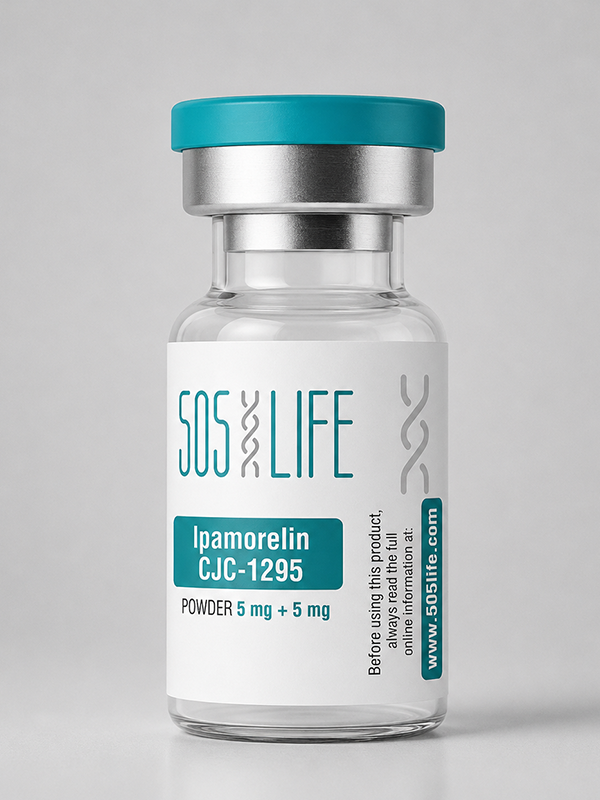
Ipamorelin 5mg + CJC-1295 5mg
Ipamorelin 10 mg research-grade lyophilized peptide powder in a glass vial. Ipamorelin is a selective growth hormone secretagogue and ghrelin/GHS-R agonist studied in models of growth hormone secretion, endocrine signaling and ghrelin-pathway research.
CJC-1295 NO DAC 5 mg research-grade lyophilized peptide powder supplied in a glass vial. CJC-1295 NO DAC, also known as Modified GRF (1-29) or Mod GRF 1-29, is a synthetic peptide analog of Growth Hormone-Releasing Hormone (GHRH) studied in experimental models of pituitary growth hormone release, GHRH receptor agonism and pulsatile GH secretion.
Ipamorelin 10mg
Ipamorelin 10 mg research-grade lyophilized peptide powder in a glass vial. Ipamorelin is a selective growth hormone secretagogue and ghrelin/GHS-R agonist studied in models of growth hormone secretion, endocrine signaling and ghrelin-pathway research.
Research Overview
Ipamorelin is a synthetic pentapeptide investigated as a selective agonist of the ghrelin/growth hormone secretagogue receptor (GHS-R). In experimental systems it is used as a tool compound to study growth hormone secretion, pituitary responsiveness and ghrelin-pathway signaling without broad off-target receptor activation.
Primary Research Areas
- Growth hormone (GH) secretion: models examining pulsatile GH release, pituitary sensitivity and GHS-R–mediated signaling.
- Ghrelin / GHS-R pathways: research on selective ghrelin receptor agonism, downstream cascades and endocrine network interactions.
- Endocrine & metabolic models: studies of hypothalamic–pituitary axes, energy-balance signaling and hormone-regulation frameworks.
- Gastrointestinal motility research: experimental systems exploring ghrelin-related effects on GI motility and smooth-muscle activity.
CJC-1295 NO DAC 5mg
CJC-1295 NO DAC 5 mg research-grade lyophilized peptide powder supplied in a glass vial. CJC-1295 NO DAC, also known as Modified GRF (1-29) or Mod GRF 1-29, is a synthetic peptide analog of Growth Hormone-Releasing Hormone (GHRH) studied in experimental models of pituitary growth hormone release, GHRH receptor agonism and pulsatile GH secretion.
Research Overview
CJC-1295 NO DAC (Modified GRF 1-29) is a synthetic analog of Growth Hormone-Releasing Hormone composed of the first 29 amino acids of native GHRH with selected substitutions to enhance stability and receptor affinity. In experimental in vitro and in vivo models it is used to investigate pituitary growth hormone release, GHRH receptor activation and short-lived, pulsatile GH secretion patterns under controlled conditions.
Primary Research Areas
- GHRH receptor agonism: used to study selective activation of the Growth Hormone-Releasing Hormone receptor and downstream cAMP/PKA signaling in pituitary and related cellular models.
- Growth hormone (GH) release: applied in experimental systems evaluating GH pulse amplitude and frequency, pituitary responsiveness and feedback regulation of the somatotropic axis.
- Pulsatile secretion patterns: investigated for its short half-life profile and use in models designed to mimic physiological, pulsatile GH release rather than continuous exposure paradigms.
- Pituitary function assessment: included in research protocols probing pituitary reserve, GH–IGF-1 axis integrity and interactions with other hypothalamic–pituitary hormones in animals and ex vivo tissues.
- Combination with GHRPs/GHSs: used in combination studies with growth hormone secretagogues (GHRPs/GHSs) to explore potential synergistic or additive effects on GH release and downstream signaling endpoints in laboratory models.
